Big Sky Country

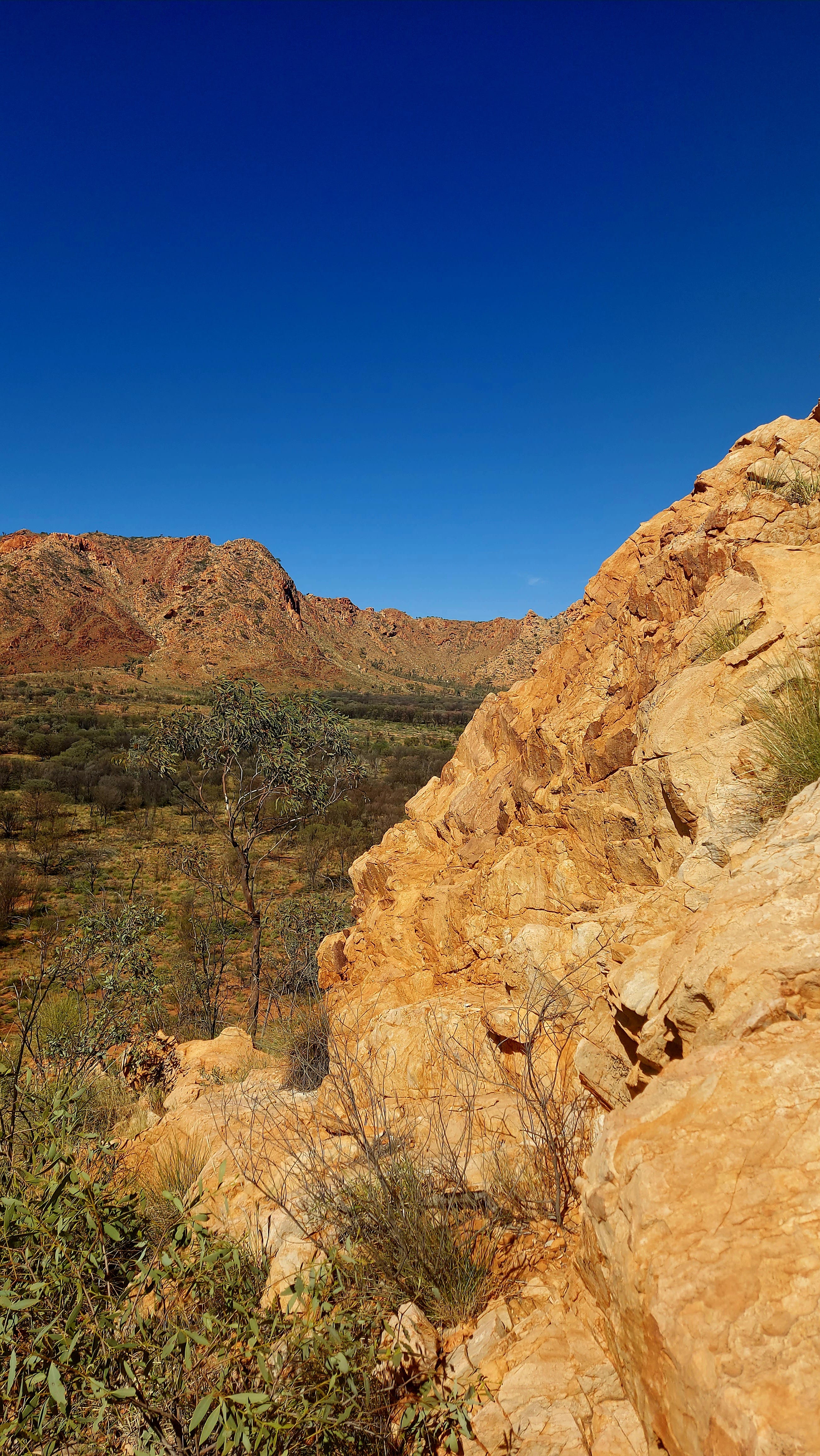
There was a moment on the walk, when I walked from the east coast of Australia to the west coast, when the sky became unreasonable.
Not just large. Unreasonable. Out past Broken Hill, where the saltbush runs flat to the horizon in every direction and there is nothing to interrupt the eye, the sky stops being backdrop and becomes the whole event. Red dirt below. Blue above. You, a thin upright thing between them, breathing.
I used to think of sky as ceiling. Out there, walking, it stopped being that. It became depth.
It’s easy to forget how little stands between us and nothing. Not a wall. Not a boundary you could touch or lean against. Just a thinning, an almost-imagined veil of gas held close by gravity. Nitrogen, oxygen, trace elements in a fragile agreement to stay. On one side is our breath, warmth, birdsong, fermentation jars quietly alive on my kitchen bench. On the other is silence, vacuum, a cold so complete it doesn’t feel like cold.
We call it the atmosphere. From far enough away, it becomes something else. A luminous edge. A thin blue line.
I have walked under that line for hours at a stretch, six thousand kilometres over a hundred and fifty-three days, watching it change from the deep copper of morning over the ranges, to the pale, bleached white of midday that seems to push the world flat, to the blue that comes in late afternoon over the desert, a blue so saturated it looks painted. The blue you see when you’ve been walking long enough that your mind quietens and your eyes go soft. That blue.
It’s the same blue the astronauts describe. The one that stops them.
Astronauts speak of a moment when the mind gives way, when the Earth, suspended in the dark, becomes not a place but a presence. No borders. No countries. No edges except that single, glowing thread. Frank White called it the ‘Overview Effect’ a sudden, undeniable knowing that everything we love, everyone we’ve ever known, exists within that narrow band of blue. Between that dirt and space.
“If you can’t take love to the stars, what are we doing? Why are we even going?” — Amit Kshatriya, NASA Associate Administrator.
I understand that question differently now. Not from space, but from the dirt.
When you walk across a continent one step at a time, the planet stops being an abstraction. You feel its tilt in the angle of the light. You feel its size in the ache of your feet. You feel its atmosphere in the way the heat sits on your skin before the sun has even cleared the ridgeline. The same force of gravity that holds the atmosphere close is the same force pulling at your pack, at your body, at the ground under each step. You are inside the system. You are part of the agreement.
This blue line does not just hold us in place. It makes us possible. Sunlight arrives and is softened, filtered, translated into warmth. The Earth exhales that warmth back toward space, and the atmosphere, in its quiet intelligence, catches it, turns it, sends it back again. A rhythm. A conversation. The greenhouse effect not a problem in itself, but a delicate balance that has allowed forests to rise, oceans to pulse, and human hands to shape clay and story.
And yet we have thickened this line in ways it cannot easily carry.
Still. From space, none of this looks like crisis. From space, it looks like beauty.
On the walk, I learned to read weather the way you learn a person, slowly, through attention, through being wrong. I learned that the quality of blue in the morning tells you something about what the afternoon will bring. I learned that dust on the horizon an hour before you can hear anything means something is coming. I learned that the sky at dusk, when the day’s heat releases and the first coolness arrives, has a particular blue-grey-purple that I now think of as the colour of exhale.
Indigenous sky country knowledge holds this. The sky is not backdrop to the land, it is continuous with it. Country includes up. The relationships between sky and soil, between rain and seed, between seasonal star patterns and when to move, these are not metaphors. They are knowledge systems, built across thousands of generations of attentiveness. What the Overview Effect gives astronauts in a single moment, sky country knowledge carries as lived, intergenerational truth which is that we are held. We are inside something. That something requires care.
It’s easy to forget how little stands between us and nothing.
Step outside at dusk and look up. You won’t see the atmosphere. Not directly. You’ll see sky the fading blue giving way to night. But it is there, holding the warmth of the day, carrying the scent of soil and salt, keeping you within the only known place in the universe where you can stand and breathe without thinking about it.
A thin blue line. Not a border, but a bond.
And perhaps the question is not only what lies beyond it, but how we choose to live within it, knowing how little there is between us and the vast, formless dark. Knowing, as you learn when you walk long enough, that everything we are exists right here in this narrow band.
If we can’t carry love this far, into the way we care for this fragile layer and into the way we see one another held inside it, then the question lingers, quiet and unresolved…
What are we doing?